

Why laminate fails when other floors survive
A laminate plank is a photo layer and a clear wear coat glued over a core of compressed wood fiber. The top is close to waterproof. The core is not. Water gets in at the click-lock seams, the cut edges near a doorway, or the gap under the baseboard, and the fiber drinks it like a sponge.
Once the core swells, it does not shrink back to its original size. The edges of each plank push up into a ridge, the seams open or peak, and the surface develops a washboard look. That is why a floor that seemed fine on Monday can look ruined by Wednesday after a dishwasher line or a water heater leak.
A laminate floor in Arroyo Grande, CA is usually a floating floor, which means the planks lock to each other and rest on a thin foam underlayment instead of being nailed or glued down. That detail matters, because water travels sideways along the underlayment and ends up several feet from where the leak started.
How fast the damage shows up
Timing is the main variable. These are typical stages, and every house differs, so treat them as a rough clock rather than a promise.
- 1
First hours
Water pools on the surface and runs into seams. The planks still look flat, but the underlayment and the subfloor edge are already taking on moisture.
- 2
Day one to two
Seams start to lift slightly and the edges feel raised under a bare foot. Pulling the floor now often saves the planks.
- 3
Day three and beyond
Cores swell, the surface cups and ridges form. Damp foam and a damp subfloor can begin to smell stale.
- 4
Past a week
Planks are usually a loss, and the wet layers below may be growing mold. At that point the question shifts from the floor to what is under it.
Call the 24/7 line and describe what you see.
Dry it or replace it: a decision table
A moisture meter and a pass with a thermal imaging camera settle this better than guessing. Use the table to see which way a floor is likely to land.
| What you see | Likely call | Why |
|---|---|---|
| Clean water, wiped up fast, seams still tight | Dry in place | Little water reached the core, and fans plus a dehumidifier can pull what did. |
| Clean water, seams lifting at one wall | Replace the affected run, dry the rest | Swollen cores do not recover, but neighboring planks may be fine. |
| Planks peaked or cupped across the room | Replace | Fiber core has swollen past the lock profile. |
| Gray or dirty water of any kind | Replace | Contaminated water soaks the core and the underlayment, and cleaning cannot reach inside. |
| Water standing under the floor for days | Replace and open the subfloor check | Hidden moisture can feed mold and loosen the subfloor. |
Water that came from a toilet overflow, a sewage backup or a flood is treated differently than a supply line leak, so say where the water came from when you call.
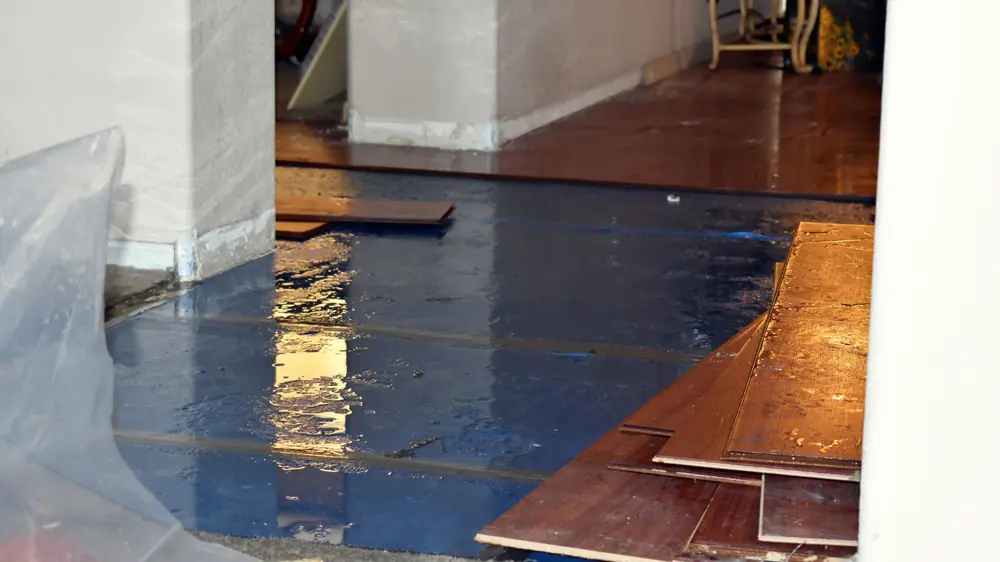
What is happening under the planks
The foam underlayment and the subfloor are where the real problem sits. Plywood and OSB subfloor can hold water for days after the surface feels dry. A pin-type moisture meter reads the wood directly, and thermal imaging shows cold, wet patches that the eye misses.
If the subfloor is on a concrete slab, moisture can wick up from below as well as down from above. Slab readings run differently from wood readings, so a technician compares wet areas against a dry spot in the same house to see what normal looks like.
Ask whether the crew works to ANSI/IICRC S500, the published standard for water damage restoration. It sets out how to classify water, set drying goals and verify that materials reached them before anything is rebuilt.
Lifting a floating floor so the layers can dry
Because the planks only lock together, a floating floor can often come up in sections without wrecking the whole room. The crew removes the baseboard or shoe molding, separates the planks starting from the wall side, and stacks the ones worth keeping. The foam underlayment usually goes in the trash because it holds water and dries slowly.
With the subfloor exposed, air movers push dry air across the surface and an LGR dehumidifier pulls moisture out of the room. Sometimes a mat system draws air through the gap under what stays. The goal is a moisture reading that matches the dry reference, not a floor that merely feels dry.
Skip the heater and the box fan. Heat can warp planks that were savable and fans without dehumidification only move wet air around. Careful extraction first, then controlled drying, is how water mitigation keeps a small leak from becoming a rebuild.
What to do in the first hour
These steps keep the damage from spreading while you wait for help.
- Stop the source: close the shutoff valve at the fixture or the main valve.
- Shut off power to wet areas only if you can reach the panel without stepping in water.
- Mop or vacuum standing water off the planks and pull rugs, furniture legs and cardboard off the floor.
- Open a few planks at the wall if you can, and photograph the damage before anything moves.
- Do not run a space heater over the floor. Keep people and pets out of any water that came from a toilet or drain.
- Call (805) 291-8940. The line is answered 24/7.
Arroyo Grande note: decide your floors before the storm
San Luis Obispo County publishes a Storm and Flood Preparation flyer in English and Spanish, and a Channel Flooding Evacuation brochure. Read them before a wet winter, then walk your own house with a pen and decide which rooms and floors you would protect first.
Laminate in a bedroom is a candidate for lifting furniture onto blocks. Laminate on a kitchen or garage-adjacent floor is a candidate for moving what you can upstairs or onto shelves. Writing that list now takes ten minutes, and it saves you from making the call while water is at the door.
Source type: San Luis Obispo County emergency preparedness page
Repair after drying
When readings come down, the rebuild is simple on paper. New underlayment, matching planks, and trim go back in. If the product is discontinued, a good installer will blend a run rather than leave a patchwork.
That stage is water damage repair, and it is separate from the drying. A repair crew that starts on a wet subfloor is setting up the next callback, so ask for readings before the new floor goes down. For homes in Grover Beach and Pismo Beach, the same sequence applies: dry, verify, then rebuild.
Insurance is general. Sudden and accidental leaks are often covered while slow leaks and neglect often are not, and flood damage usually needs separate flood coverage. Check your policy and ask your insurer, and keep your photos.
Next step
If laminate near you is lifting or a leak soaked the floor, do not wait to see if the planks flatten. Want your real number? Call (805) 291-8940.
Questions Homeowners Ask
Can swollen laminate flooring go back to normal?
Almost never. Once the fiber core has absorbed water and expanded, the plank stays larger than its lock profile. Light cupping from a very short exposure sometimes eases as it dries, but ridged seams usually mean replacement.
How long does it take to dry the area under laminate?
It depends on how much water reached the subfloor and the humidity in the house. Drying is measured with a moisture meter and usually takes several days, not hours. The crew decides the end point by readings.
Do I have to replace the whole room if a few planks are damaged?
Not always. Floating planks can sometimes be replaced in a run from the damaged wall. If the product is gone from stores or the damage reaches more than one room, a larger replacement may look better.
Can mold grow under laminate after a leak?
Mold needs moisture, and trapped water under the planks and foam gives it some. If a floor stayed wet more than a day or two, have the subfloor checked before reinstalling. Testing and remediation follow ANSI/IICRC S520, and health questions belong to a physician.
Which Arroyo Grande documents should I read before a storm season?
The county's Storm and Flood Preparation flyer and its Channel Flooding Evacuation brochure, both on the county emergency page. Use them to decide which floors and rooms you will protect first.
Will you pull the floor and dry it at night?
Yes, the line is answered 24/7 and same-day response is offered when available. Scope and price are explained before work starts.