
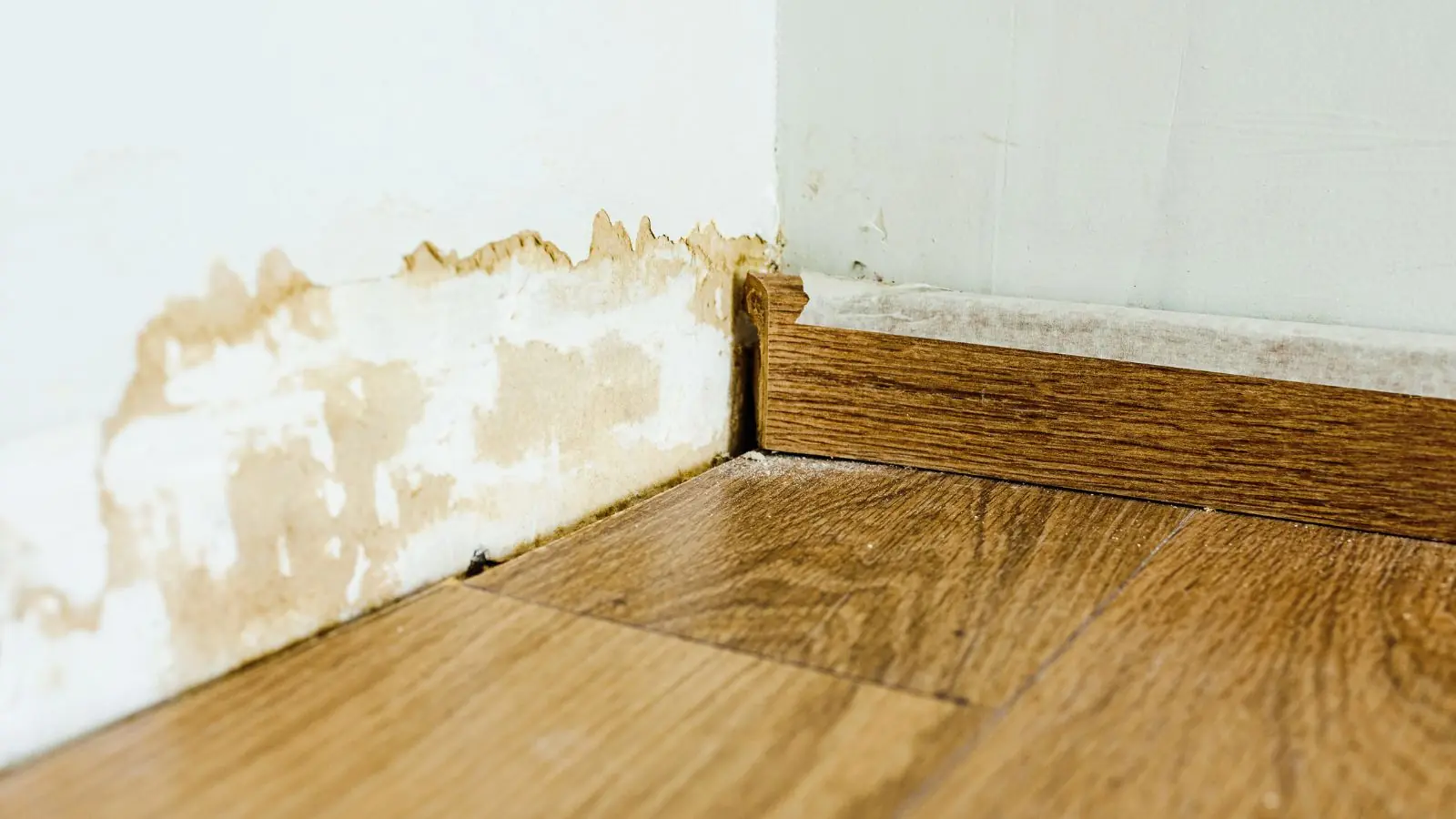
Start with the walls and ceilings
The first thing most people see is a stain. Brown or yellow patches on a ceiling are usually water that traveled through drywall and carried dust and tannins with it. A stain with a darker ring around the edge often means the area got wet, dried, then got wet again, which points to a leak that comes and goes.
Bubbling or peeling paint tells a different story. Moisture is pushing outward from behind the paint film, and the bubble may be soft and cool to the touch. If you press a fingertip into a bubble and it feels like a damp sponge, there is water in the wall cavity, not just on the surface.
Soft drywall is the sign that matters most. Press a thumb into the lower few inches of a wall. Drywall that gives, crumbles or feels like wet cardboard has absorbed enough water that it needs to be opened up and dried or cut out.
Signs low in the house and under your feet
Floors and baseboards show water earlier than walls do, because water runs down and sits at the lowest edge.
Warped baseboards
A baseboard that curls away from the wall or shows a dark line along its top edge has been soaking from behind. Check where it meets the floor for gaps.
Cupped hardwood
The edges of each board rise higher than the middle, so the floor looks like shallow troughs. It usually means moisture from below, such as a slab, a plumbing leak or a crawl space.
Lifting laminate or vinyl
Seams peak and corners curl. Both mean water reached the layer beneath the surface.
Stained carpet edges
Dark, dirty-looking lines at the edge of a room are often wicking moisture rather than dirt.
Call the 24/7 line and describe what you see.
Smell, sound and surface clues
A musty smell with no visible source is a clue in itself. It can come from damp insulation, a wet subfloor or a wall cavity that never dried. Sniff in closets that back onto bathrooms and in the cabinet under the sink, where small leaks hide.
White, chalky or crystal-like deposits on concrete or brick are efflorescence. They are salts left behind when water moved through the masonry and evaporated. The deposits are not mold, but they tell you that water has been moving through a wall or slab.
Listen too. A faint hiss behind a wall or a meter that keeps turning when every fixture is off points to a pressurized supply leak, the kind that soaks drywall quietly for weeks.

Signs after flooding: tide lines and silt
After water from outside enters a house, it leaves a tide line, a horizontal mark on walls, cabinets or garage framing that shows how high the water stood. Below that line, expect wet insulation, swollen baseboards and soft drywall even if the surface looks dry.
A fine layer of silt or gritty residue on the floor shows that water came from outside, and that matters for sorting the water by category. Flood and storm water is treated as contaminated, and porous materials below the line are often removed rather than cleaned.
Sign, likely cause, next step
Use this as a first read. A moisture meter and thermal imaging camera confirm what the eye suggests.
| Sign | Likely cause | Next step |
|---|---|---|
| Brown ring on ceiling | Roof leak or upstairs plumbing | Find and stop the source, then have the ceiling checked for wet insulation |
| Bubbling paint | Moisture behind the wall | Press-test, then get a moisture reading before painting |
| Soft drywall at the base | Past leak, flood or wicking | Open or cut out wet drywall, dry the cavity |
| Warped baseboards | Water behind the wall or on the floor | Check floor and wall base with a meter |
| Cupped hardwood | Moisture from below | Find the source, dry, wait before sanding |
| Musty smell, no stain | Hidden wet material | Thermal scan and meter survey |
| White crust on masonry | Water moving through concrete | Check drainage and gutters, then test for dampness |
| Tide line on walls | Outside water entered | Assume contaminated water, call for cleanup |
Arroyo Grande note: look low after a hard winter
After the severe 2023 storms, San Luis Obispo County removed about 11,500 cubic yards of sediment from the Arroyo Grande Creek channel to restore its capacity. That tells you how much material a wet winter can move.
After a storm winter, do a slow walk along the lower three feet of your garage and ground-floor walls. Look for tide lines, silt on the slab, swollen baseboards and white mineral crust on concrete, then photograph what you find with a date.
Source type: San Luis Obispo County Public Works
What to do when you spot one
You do not need to diagnose the cause on your own. A short sequence keeps damage from growing.
- Photograph the sign with something for scale and note the date.
- Check for an active source, such as a dripping pipe, a wet roof area or a running appliance line.
- If you find one, shut off the water at the fixture or main valve.
- Keep people and pets away from any area with a tide line or sewage smell.
- Do not paint or caulk over stains. Sealing in moisture hides the evidence.
- Call (805) 291-8940 and describe the sign, where it is and what you already did.
What a professional looks at next
A restoration crew maps the damage rather than trusting the stain. Moisture meters read wood and drywall, thermal imaging finds wet cavities behind intact surfaces, and a hygrometer records the humidity of the room. The pattern shows where the water came from and how far it traveled.
If it is fresh, water damage cleanup removes wet material and starts drying. If the drywall has been wet for days, water mitigation steps focus on drying cavities before mold takes hold. Residents of Nipomo and Oceano can reach the same line, answered 24/7.
Closing the loop
If you recognize a sign here in your own house, treat it as water until a meter says otherwise. Call (805) 291-8940 and we will send a licensed and insured crew when available.
Questions Homeowners Ask
Does a stain always mean there is an active leak?
No. A stain can be a record of a leak that has stopped. A ring that looks darker or feels damp is more worrying than a dry, faded one. A meter reading tells you whether it is wet now.
Is white powder on a basement wall mold?
Usually it is efflorescence, a mineral salt left behind when water moves through concrete. It is not mold, but it signals that moisture is moving through the wall. Mold testing, if needed, follows ANSI/IICRC S520.
How can I tell if drywall is ruined?
Press the lower wall. If it crumbles, sags or stays soft, it has lost strength. Drywall that stayed wet for days is generally cut out.
Can water damage be hidden inside walls?
Yes. Thermal imaging and moisture meters find wet insulation and framing behind walls that look dry. A musty smell with no visible stain is a reason to scan.
What should I check in my Arroyo Grande garage after a stormy winter?
Look along the bottom three feet of the walls and the slab for tide lines, silt, swollen trim and white crust. The county cleared about 11,500 cubic yards of sediment from the creek channel after the 2023 storms, so a wet winter is a good reason to inspect.
Does homeowners insurance cover the damage I see?
It depends on how the water got in. Sudden and accidental leaks are often covered, gradual leaks and neglect often are not, and flood usually needs separate flood coverage. Check your policy and ask your insurer.